Finding the Soul of a Place
As emerging photographers, we are often taught to master the light, the composition, and the gear. But during my Director’s Fellowship at the International Center of Photography (ICP) in New York, I was recently reminded of a much harder challenge: how to capture the invisible.
Our latest assignment was to document a "Sense of Place." The prompt was a reminder that a photograph shouldn’t just show where you were—it should articulate how that space feels.
What "Sense of Place" Means in a Photograph
Think of it as photographing the DNA of a location. A strong "Sense of Place" image doesn’t just provide a factual rendering; it makes the viewer feel like they are standing there, experiencing the specific weight, sound, and history of the moment. It’s about capturing the intangible—the mood of a quiet corner, the energy of a crowded street, or the loneliness of a room that hasn't been touched in years. In my work, the space transforms into a stage for human behavior, revealing themes of neglect, isolation, and the deep-seated influence of our heritage.
The Journey into the Back Room
For this project, I stepped away from the public-facing storefront of a family "mom and pop" shop and moved into the liminal space behind it. I found myself in a back-room area that serves as a bridge between a business and a home. It is a cluttered, quiet transition zone where the past hasn’t been cleared away, but rather layered upon. To navigate this world, I imagined a protagonist—a "Chinese Alice in Wonderland"—exploring a landscape of relics.
How the Images Articulate the "Sense"
When I entered this space, I realized that a "Sense of Place" is often found in the things that are no longer "turned on." I focused on the absence of power: a television that is off, a neon sign that is dark, and a life seen through a grainy surveillance feed.
Here is how the story unfolded:
FIRST IMAGE: THE THRESHOLD
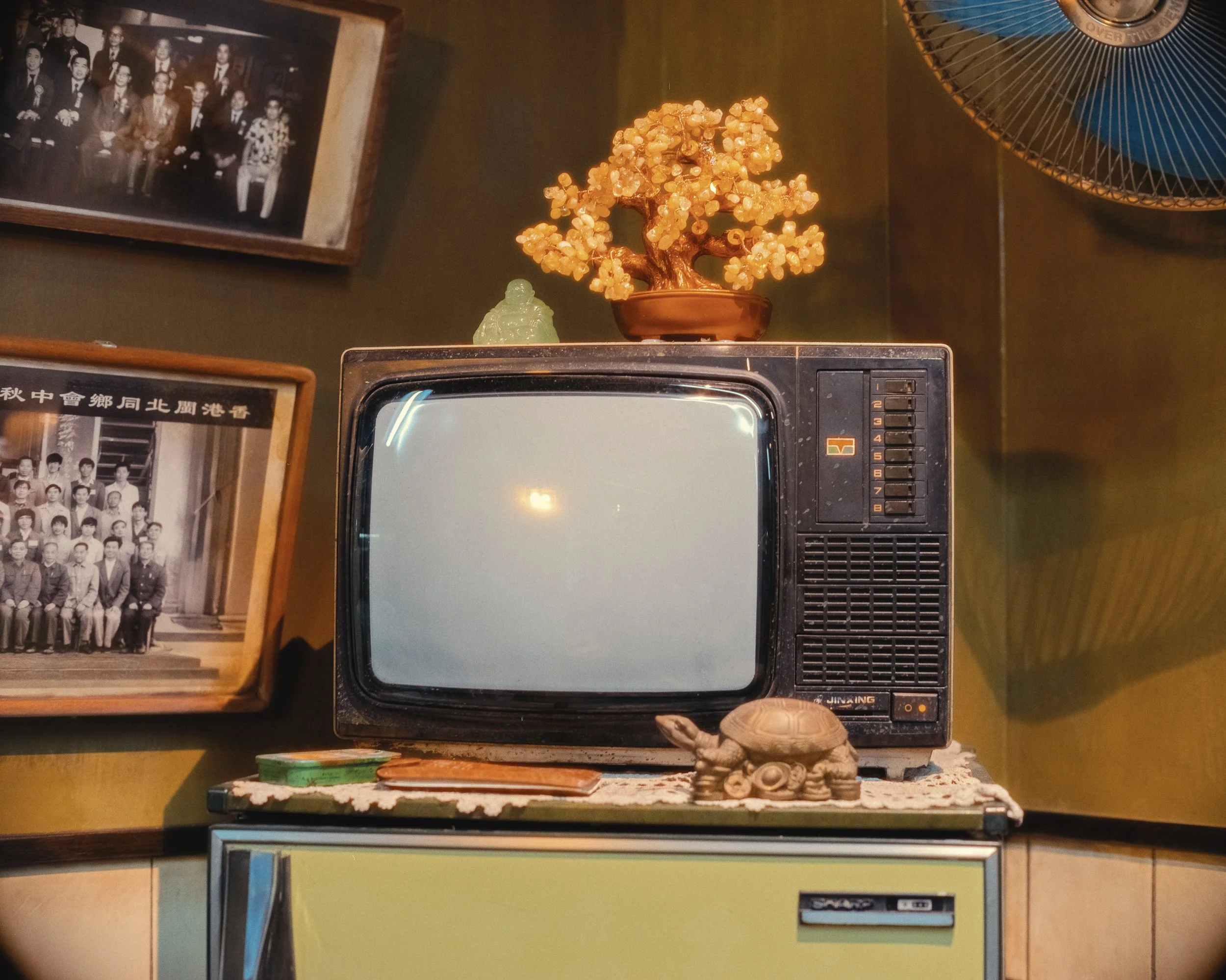
The journey begins with an old television sitting on a jade-green refrigerator. In a liminal space like this, objects just kind of accumulate. The TV is the protagonist here; it’s off, but it reflects a golden light that makes it feel like it’s holding a secret. Surrounded by a Buddha statue, a bonsai, and old black-and-white portraits, it feels like a shrine to a different era. It sets the mood—a place frozen while the world outside keeps moving. The "place" feels like a time capsule that has held its breath.
SECOND IMAGE: THE VISITOR
This is where we meet our "Alice." Her fluorescent blue hair vibrates against the backdrop of traditional wooden birdcages, and this clash articulates curiosity and displacement. By shooting her from a low angle, I wanted her to look like a time traveler who just landed in her grandparents' past. Behind her, a dormant neon sign hints at a heritage that feels both familiar and totally alien to her modern identity.
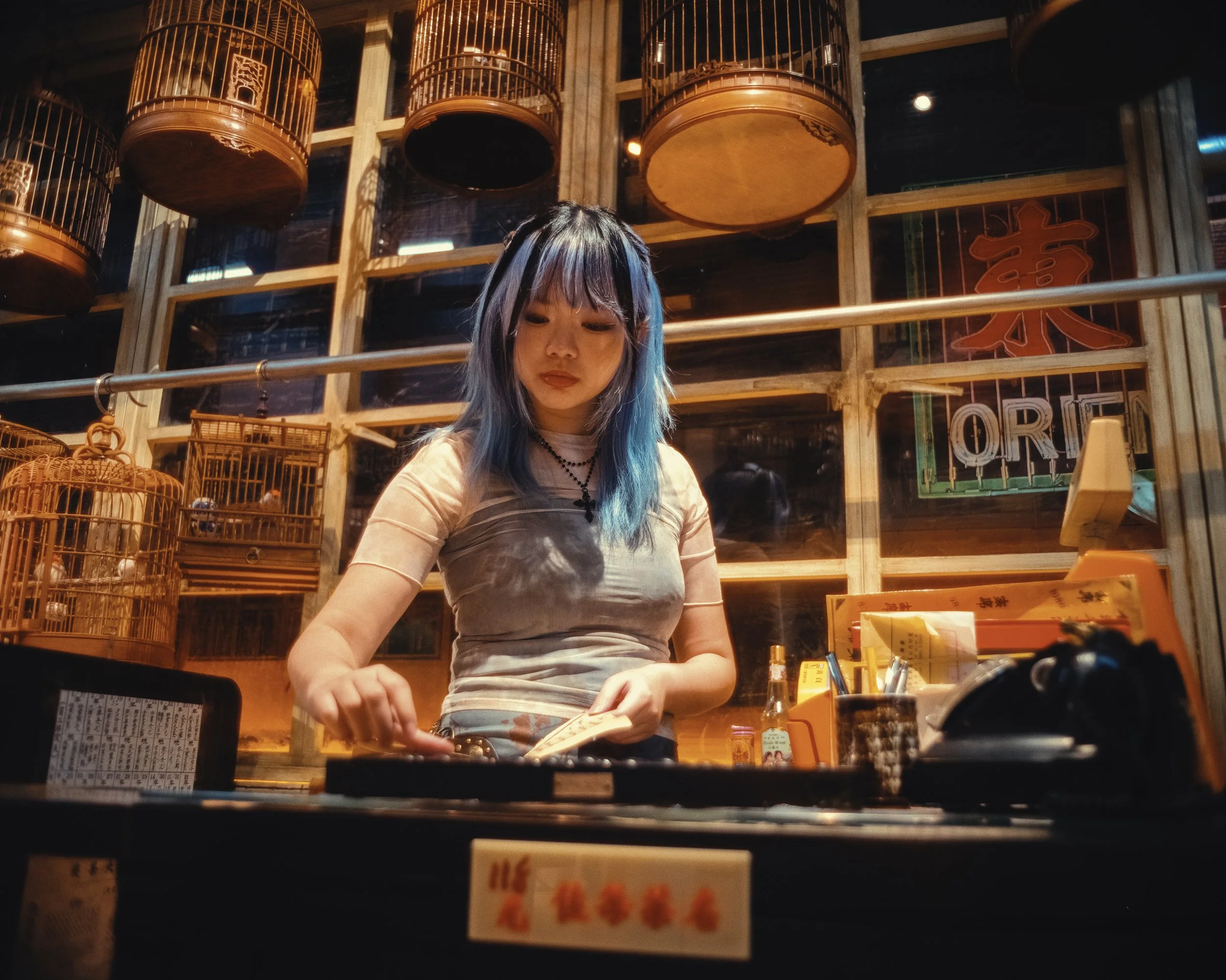
IMAGE THREE: THE RELIC
In this intimate, top-down shot, we see what she was digging through. Her hands hold a handwritten diary with vertical Chinese text, resting next to a Suanpan (abacus). This "counting tray" isn't used for business anymore; it’s a relic of a manual, deliberate past. I wanted this shot to feel very tactile—focusing on the weight of a history that is no longer active, but still physically present.
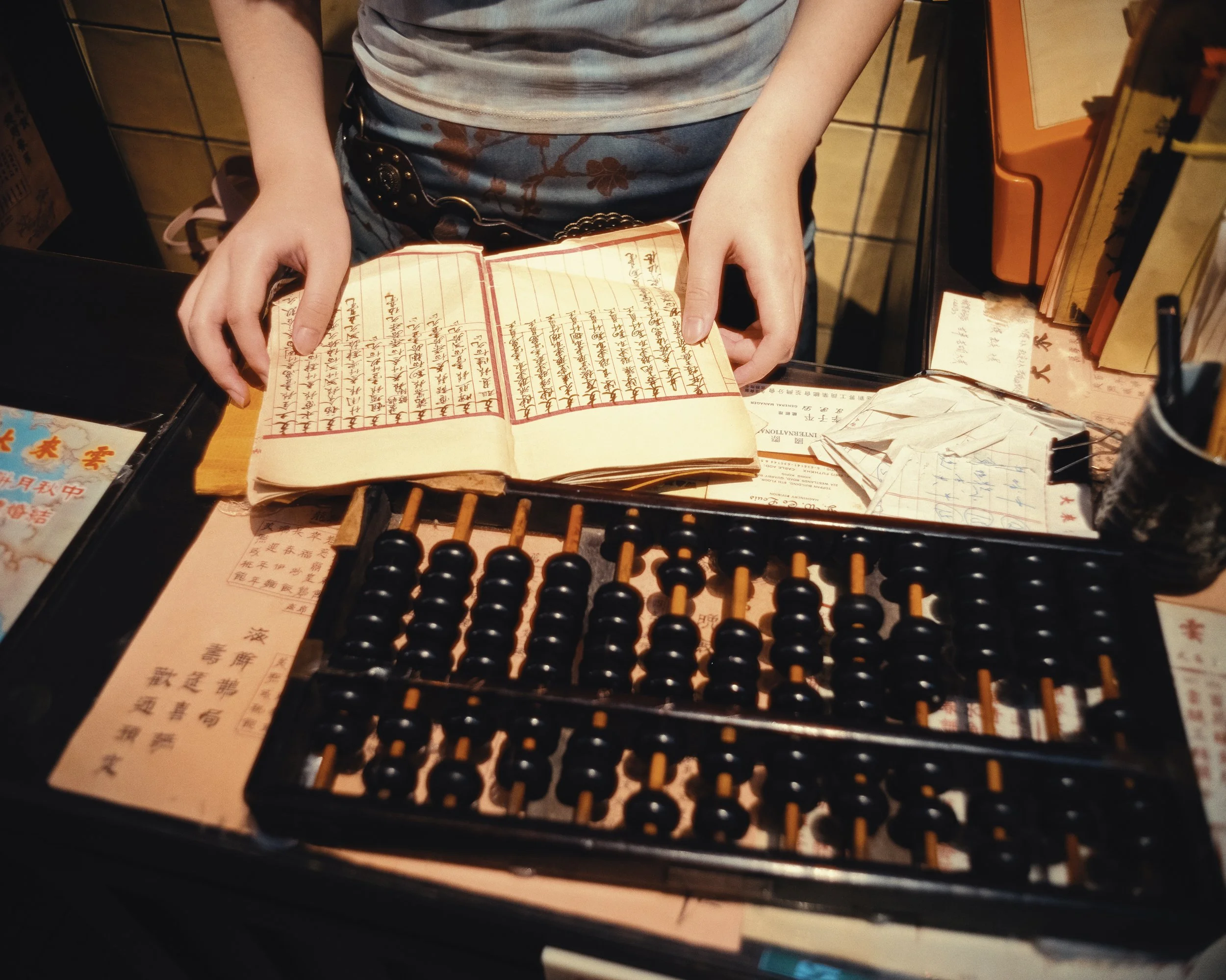
IMAGE FOUR: THE EMOTIONAL ECHO
Every legacy has a heavier side, even if it’s not your own. While digging through the backroom, we found a collection of discarded prints, and this one Polaroid stood out. It’s a tight shot of a man on a rotary phone, his eyes closed in what looks like total despair. Even though he isn’t a member of the family, his image has become part of the room’s DNA. By placing the girl’s hand next to it, I wanted to show her witnessing the human cost that permeates these kinds of spaces. It articulates a quiet, heavy realization: that the 'sense' of this place is built on the collective labor and exhaustion of everyone who ever struggled within its walls, whether they are related to us or not.
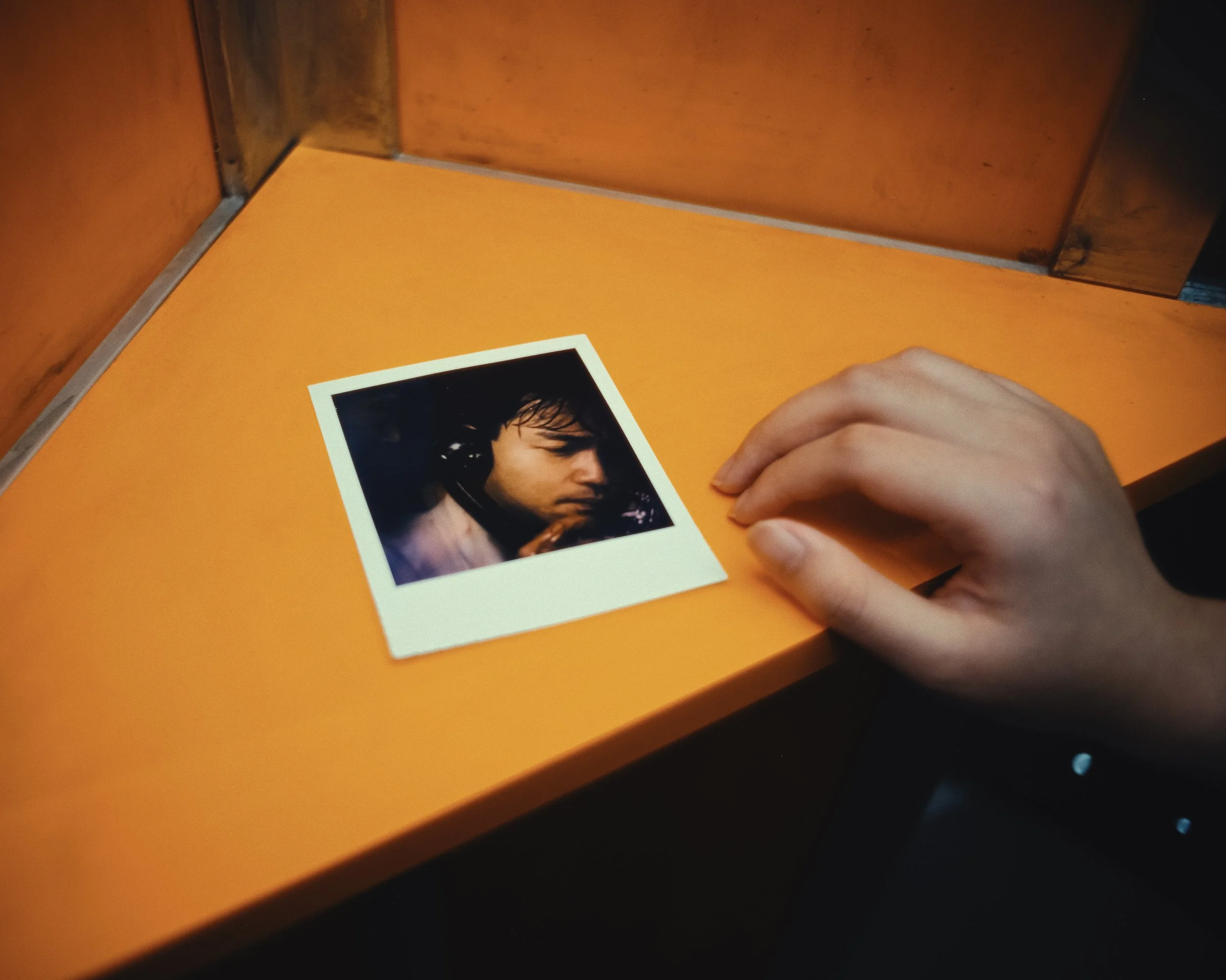
IMAGE FIVE: THE RETURN (THE MONITORED WORLD)
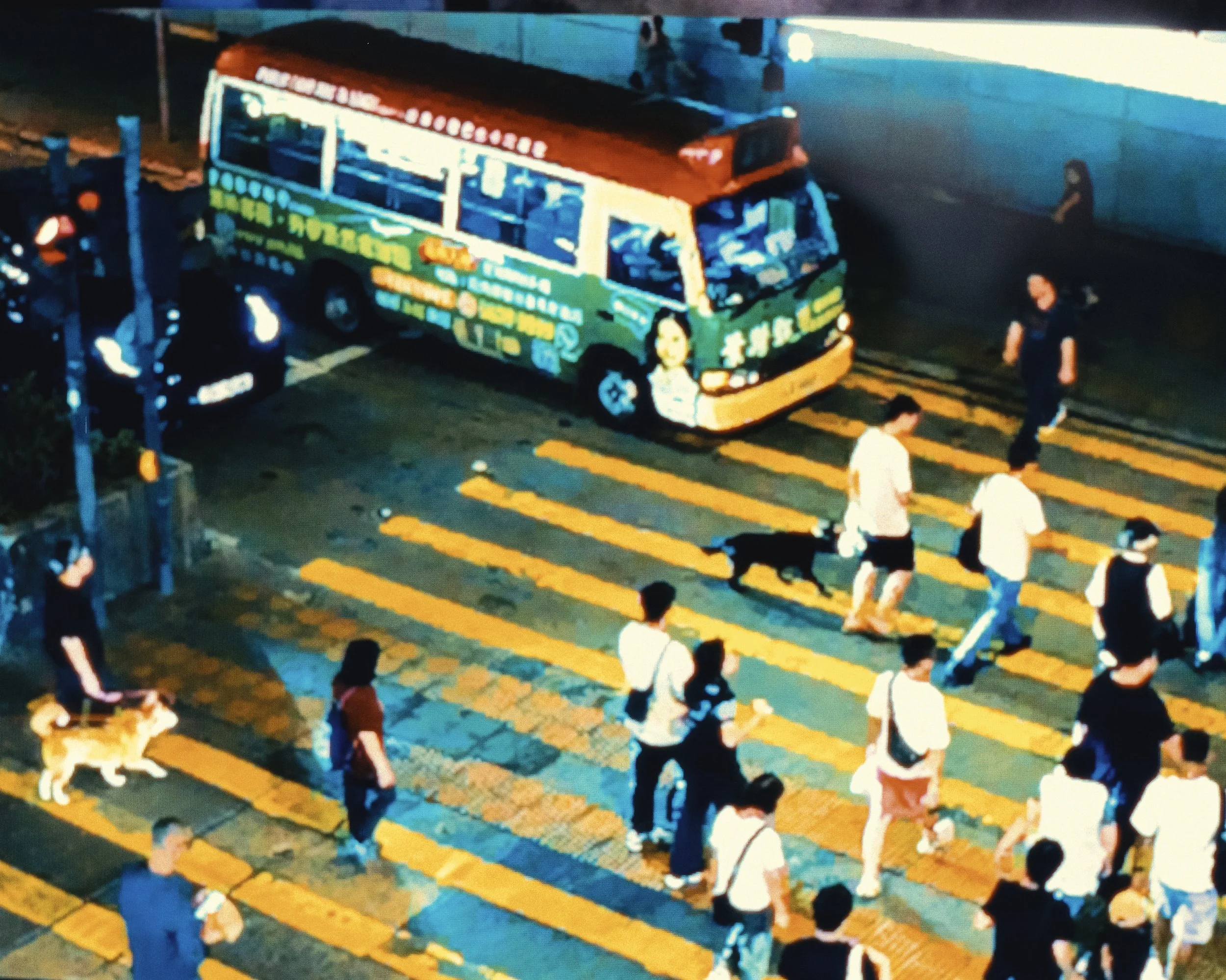
The series ends by looking at the street outside, but not directly. This is a photograph of a CCTV monitor inside the backroom. The high angle and motion blur render the people outside as flickering ghosts, culminating in a moment of tension as a bus slams on its brakes for a man walking against the tide. By viewing the present through this grainy, windowless transmission, the "sense" of the space becomes one of confinement. It suggests that while our protagonist is deep in the past, this screen is her only tether to a world that now feels like speculative fiction—articulating a profound disconnection from the modern world.
What Emerging Photographers Can Learn
If you are struggling to find the "soul" of a location, my advice is to stop looking for the "perfect" shot and start looking for the liminality.
Look for the "In-Between": The most interesting stories are often in the back rooms, the hallways, or the storage areas where things go to be forgotten.
Focus on Relics: Objects that have lost their original function—like an old abacus or a dead neon sign—often carry the most atmospheric weight. They represent the "breath" of a place that has slowed down.
Embrace the Filter: Whether it’s a reflection in an old TV or a grainy CCTV feed, using "layers" between your lens and the subject can add a sense of mystery and distance.
Finding the soul of a place is about the difference between a floor plan and a memory. It’s about realizing that a space can hold onto the exhaustion, the pride, and the dreams of everyone who passed through it.