The Symphony of Seeing: Sequencing a Photo Essay as a Musical Composition
We're taught to build narratives the way architects build houses—foundation first, then walls, then roof. Opening image establishes the scene. Middle images develop the story. Closing image provides resolution. It's clean, logical, and utterly predictable.
But what if the most honest stories don't follow blueprints? What if they move the way music moves—in swells and silences, in unexpected key changes, in motifs that appear and disappear and return transformed?
This question became an obsession after discovering how Christopher Anderson sequences his photo essays. He doesn't edit with his eyes alone. He edits with his ears—listening for rhythm, for tempo, for the spaces between frames. Each image becomes an instrument in a larger composition. The job of the photographer isn't just to take pictures. It's to conduct them.
So I decided to experiment. I spent a weekend traveling through Zhangjiajie National Forest Park and the ancient city of Fenghuang Gucheng with my Fujifilm GFX 50R medium format camera and a vintage Minolta lens, determined to create an eight-image sequence that worked like music. But then my mentor, Stephen Ferry pushed me further. He suggested a sequence so counterintuitive, so wrong by every conventional standard, that I almost refused.
He wanted me to put the sunset in the middle. And save the mountains for after the divine had already appeared.
This is the story of taking that risk. Of learning that the most powerful narratives don't follow maps—they follow instincts. And of discovering, along the way, that the Fox Spirit I've been chasing in my larger project Love Like a Fox doesn't reveal herself in grand finales. She appears in the places we least expect: in ribbons tied to trees, in sunsets that interrupt us mid-journey, in bowls of noodles waiting to be mixed.
The Overture: A Quiet Invitation
Image 1: The Ribbon
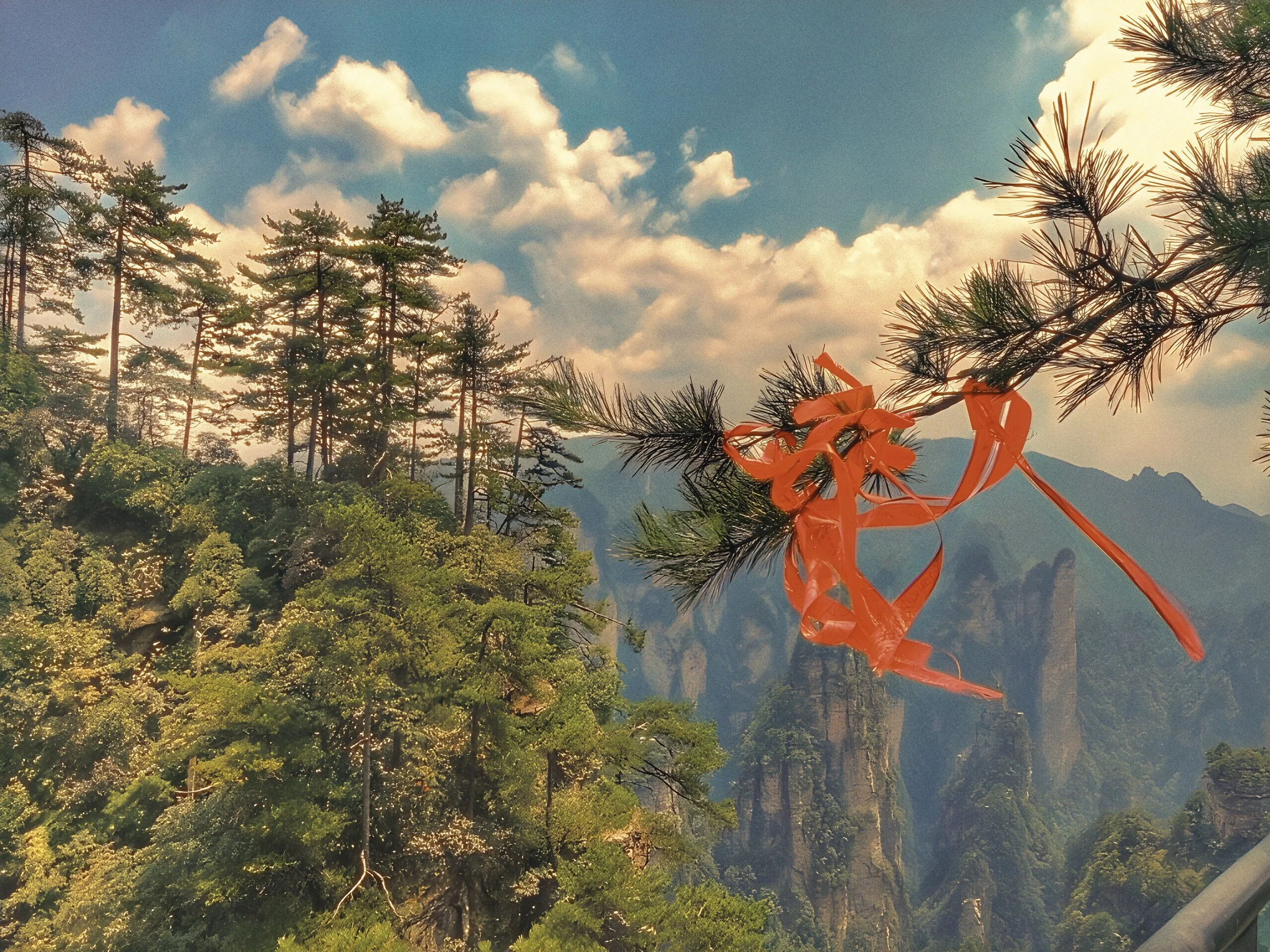
A scarlet red ribbon tied to a tree branch appears from the top right corner of the frame, reaching down like a hand offering a gift.
In Chinese culture, scarlet ribbons carry deep meaning. They are traditional symbols of good luck, prosperity, and blessings for the future—tied along walking paths and in sacred areas to express wishes, gratitude, or to seek divine intervention.
This image is the perfect opener. It doesn't announce itself with grandeur. Instead, it invites. It whispers. If this were a symphony, we would hear a single instrument—a flute, maybe, or a lone violin—playing a note that lingers just long enough to make us lean forward. The pilgrimage begins not with a declaration, but with a prayer.
The First Movement: Longing and Celebration
Image 2: The Bride
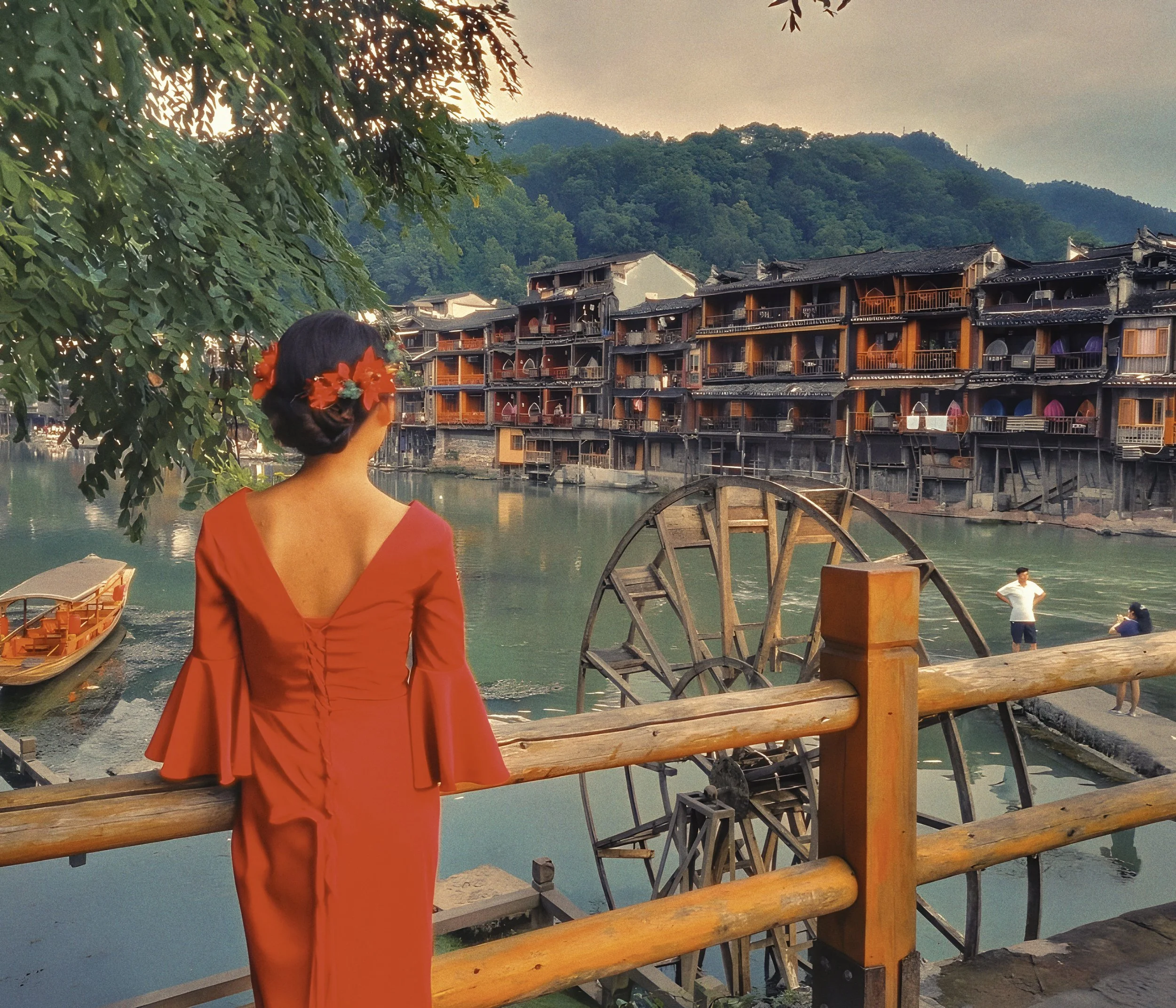
From the intimacy of the ribbon, we now encounter a figure in scarlet—a bride, her back to us, standing at the edge of a lake. Scarlet flowers adorn her hair as she gazes across the water toward a village on the far shore. The ribbon has transformed, now embodied in wedding silk, carrying its blessing into human form. She is looking into her future, and we are witnesses at the threshold.
To her right, a wooden waterwheel stands still—its shape a visual note that will echo later. At the water's edge below, a narrow stone platform extends into the lake, where two figures face each other from opposite ends: a man and a woman, suspended in the space between. Strangers? Lovers? Two souls about to cross paths? The mind fills with possibilities.
The music deepens here. The cello enters, low and resonant, while violins hold a long, searching note. We are entering the territory of longing, of futures imagined, of love in all its forms.
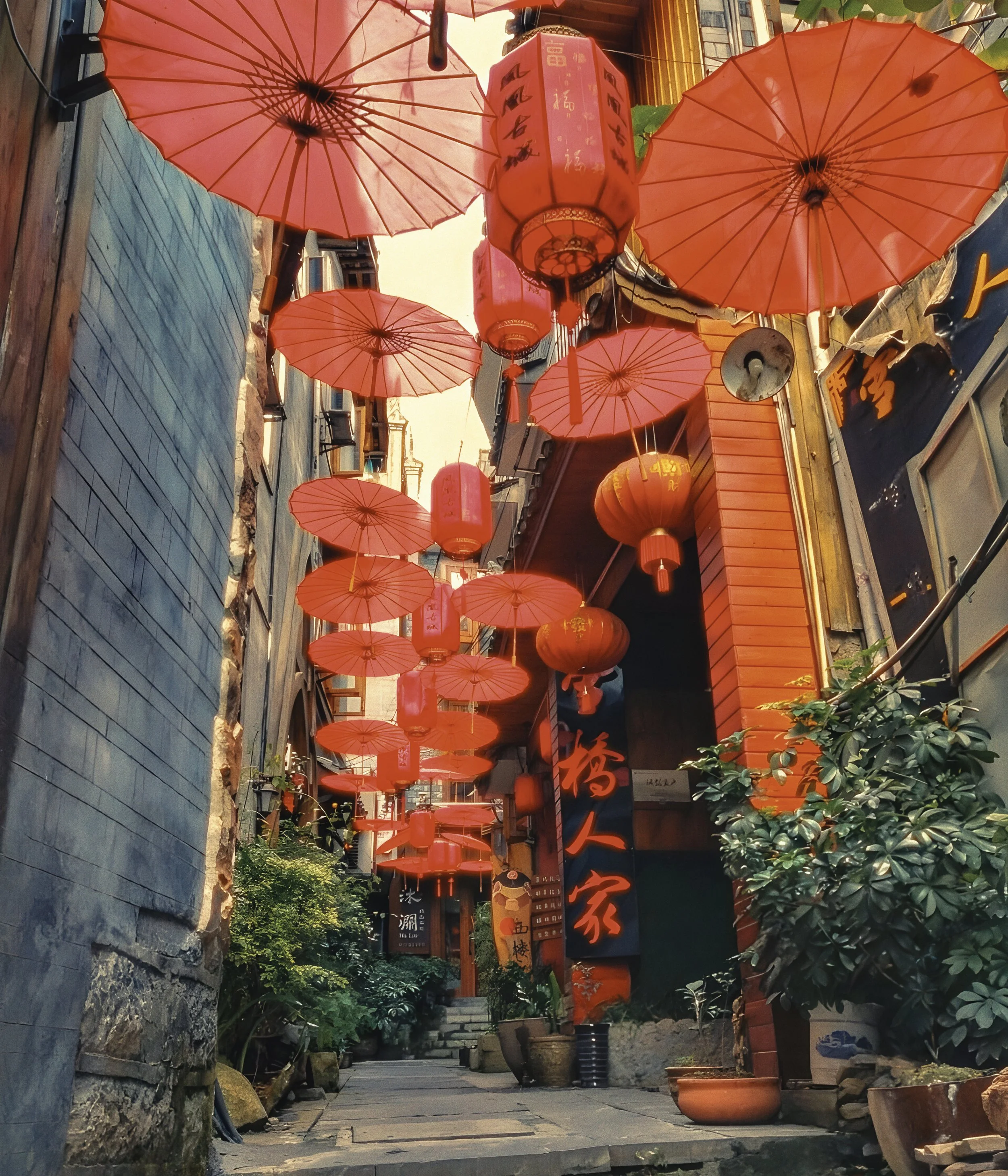
Image 3: The Lanterns
The third image shifts the rhythm—vertical where the first two were horizontal, a change in breath, in posture. We are looking up at an alley where scarlet paper lanterns and circular umbrellas form an imaginary roof, suspended like celebration caught mid-air.
Here, the scarlet transcends its earlier forms. No longer ribbon, no longer wedding silk—now it becomes architecture, atmosphere, immersion. The lanterns and umbrellas seem to turn with an invisible current, as if the music itself has become visible, spiraling upward in celebration of what love might bring.
This alley is an invitation. Perhaps it's the path the bride took toward her future. Perhaps it's the path for the solitary figures at the water's edge. Or perhaps it's the path for me—the photographer, the seeker.
The music swells. Strings give way to something brighter—woodwinds, chimes, celebration. We are being welcomed.
The Second Movement: The Divine Interruption
Image 4: The Sunset Bridge
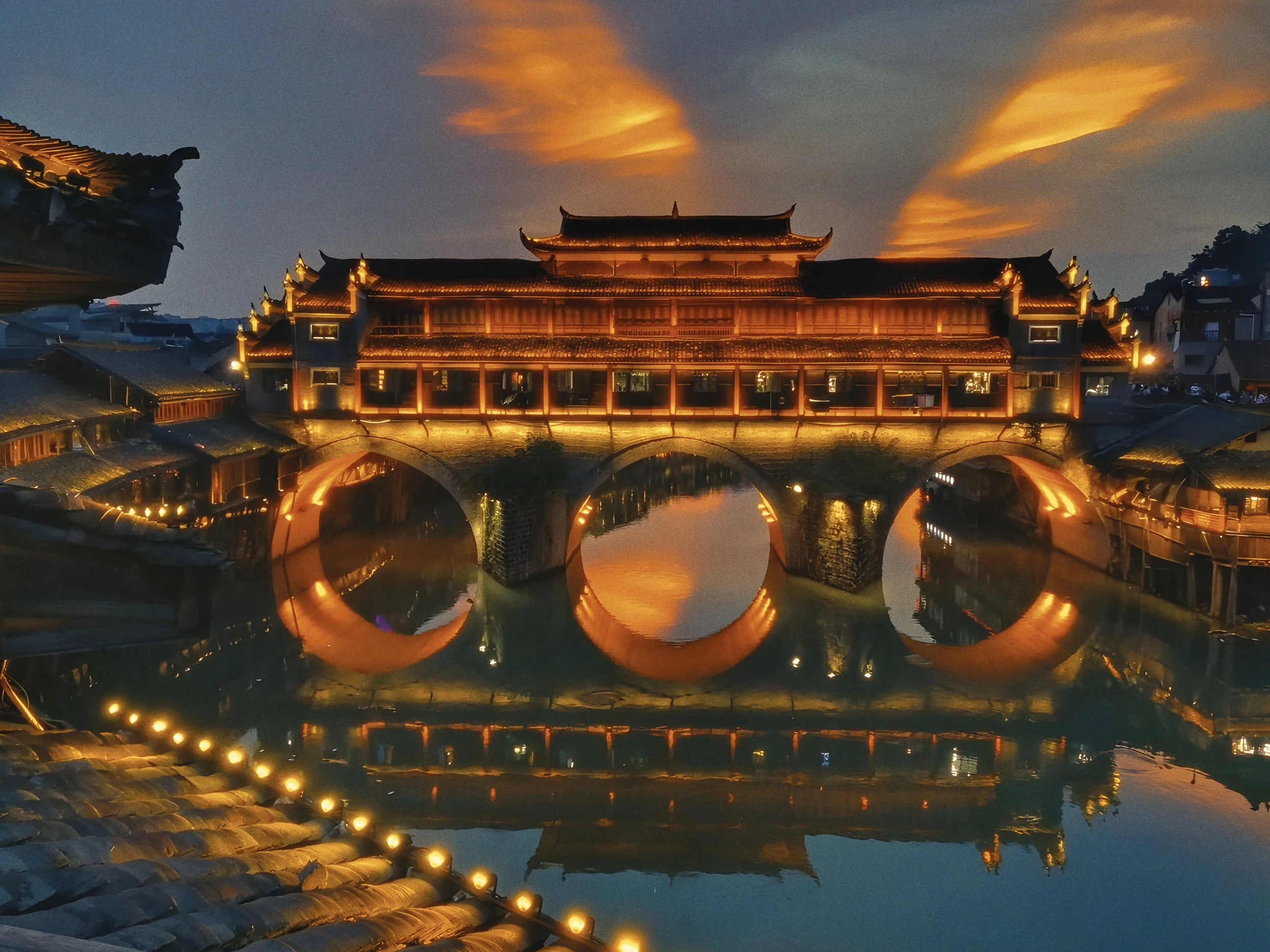
And then, unexpectedly, the divine appears.
This is the creative risk—placing the sunset here, in the middle of the sequence, before the mountains, before the labor, before the meal. It shouldn't work by conventional storytelling rules. The climax belongs at the end, doesn't it?
But life doesn't work that way. Grace doesn't wait until we've earned it. Mystery interrupts us when we least expect it, changing everything that follows.
Ancient Chinese architecture crowns a bridge, its reflection perfectly mirrored in the foreground lake. Beneath it, three circular canal pathways open like portals—circles within circles. The sun is setting. In the sky, two rays of light spread outward like wings—an angel, a blessing, a divine presence. It is unclear whether this light emerges from the architecture or simply from clouds parting at golden hour. That uncertainty is the point.
The music here is not triumphant. It is something more profound: a moment of stillness, of awe, of being witnessed by something larger than ourselves. The symphony pauses. We are held in mystery.
And then we keep going.
The Third Movement: The World Transformed
Image 5: The Mountains (The Crescendo)
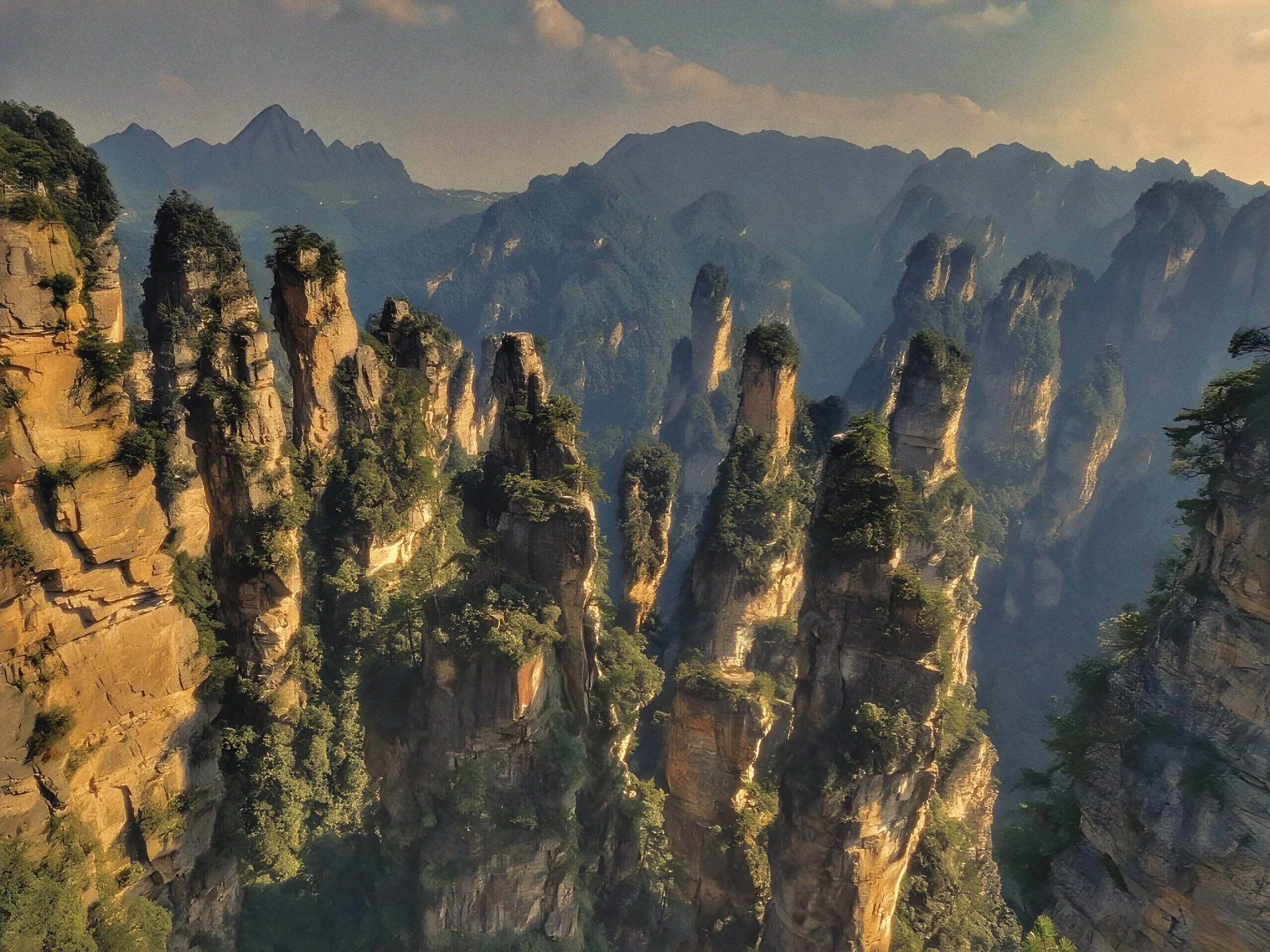
After the sunset, we finally enter the mountains—but now they are different. We carry the memory of that golden light with us.
A wide landscape of Zhangjiajie's sandstone pillars rises through mist. We stand as if on a cliff across from this sea of ancient stone, suspended in possibility. The view is magical, otherworldly—the kind of sight that stops time.
But this is no longer just a landscape. It has become a response. Having witnessed something mysterious—that moment when sunset transformed bridge into cathedral—we now see the world through changed eyes. The mountains are not just mountains anymore. The mist is not just weather.
This is the crescendo—not because the mountains are grander than the sunset, but because they arrive after mystery, carrying its weight. The music swells, full orchestra now, every instrument playing toward something.
Image 6: The Spices
From the vastness of mountains, we return to earth. Three trays dry in the sun: two round, one square, each filled with scarlet chilies. A large round straw tray dominates the upper frame, while a smaller round container rests below left, and a square tray with a gold border sits below right.
The round shapes echo everything that came before—the umbrellas, the lanterns, the bride's imagined future, the canal pathways beneath the bridge. But now, after the sunset and the mountains, these spices feel different. They are not just ingredients. They are offerings.
At the lower edge of the frame, two feet appear—mine. The seeker, finally visible. Standing at the threshold of gifts the land provides, still carrying the weight of everything witnessed so far.
The music settles into something meditative. The ingredients are readying themselves.
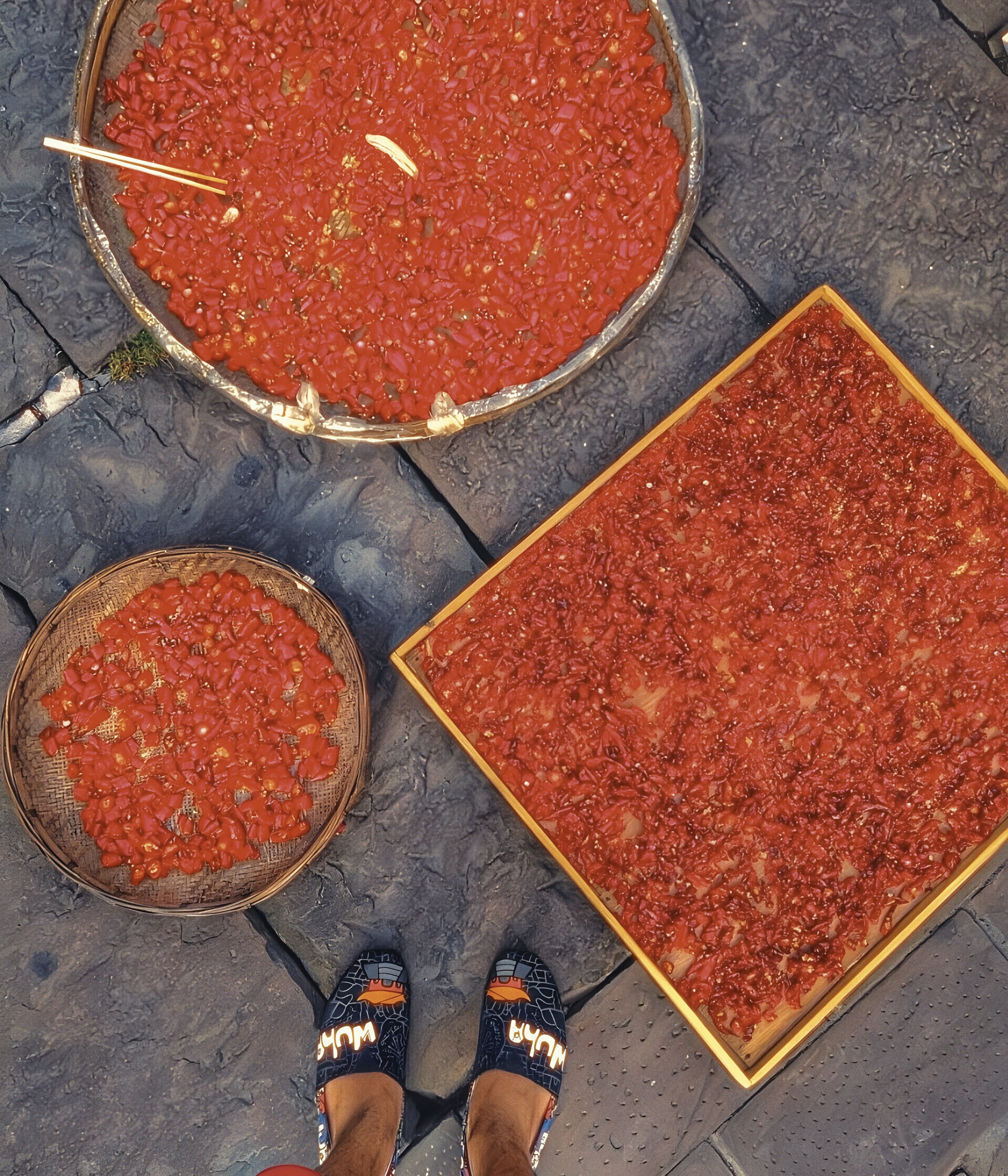
Image 7: The Preparer
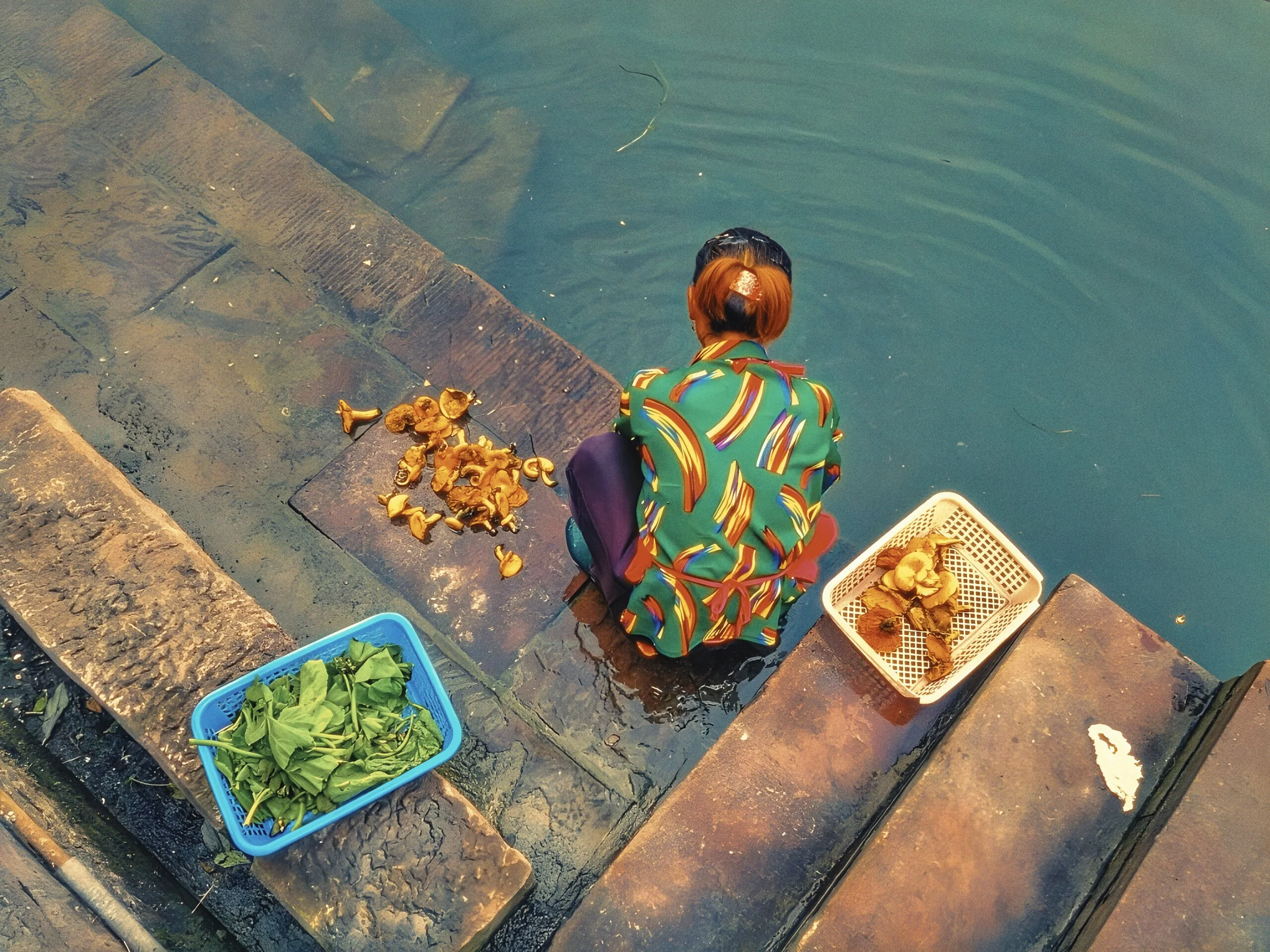
A high angle shot looks down at a woman squatting at the water's edge, her hands deep in preparation. Freshly washed brown mushrooms rest scattered beside her. A blue basket holds green leaves; a white basket cradles more wild mushrooms. The arrangement echoes the three trays of spices.
Her green shirt carries brushstroke stripes of yellow and scarlet, and her apron ribbon is scarlet—the motif persisting, connecting her to the bride's flowers, to the ribbon on the tree, to the lanterns overhead, to the chilies drying in the sun. She is the invisible hand behind what comes next, the labor that transforms blessing into sustenance.
The music here is steady, rhythmic—the sound of work that is also love, of hands that prepare not just food but possibility.
Image 8: The Bowl
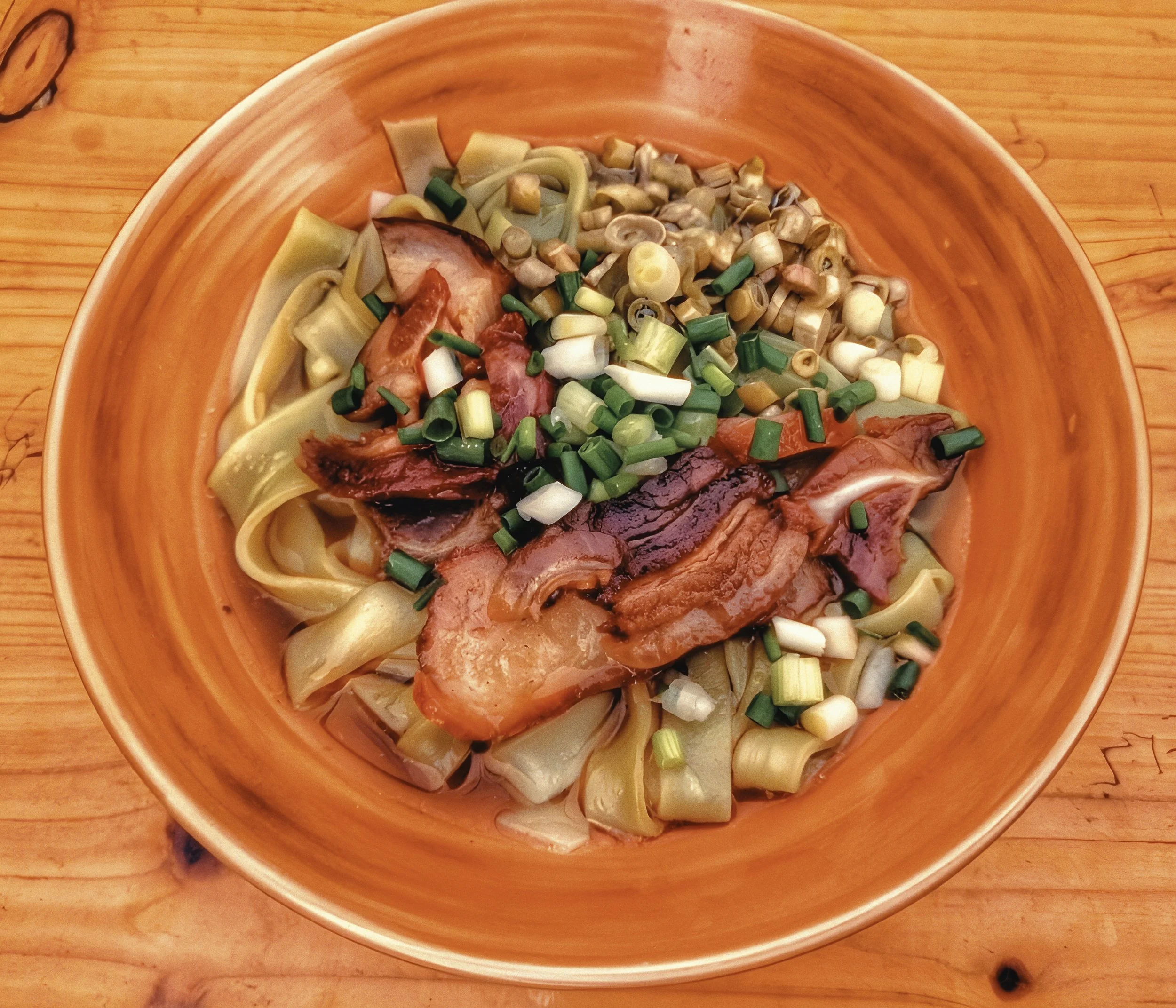
The bowl arrives last—and now it carries everything.
Wide brown rim, wooden table, rice noodles as foundation, mushrooms, green onions, chive—all waiting, unmixed, full of choice. The circular form holds not just a meal, but the entire journey: the ribbon's blessing, the bride's longing, the lanterns' celebration, the sunset's mystery, the mountains' majesty, the spices' promise, the woman's labor.
After all of it—the prayer, the longing, the celebration, the divine interruption, the awe, the preparation—we finally sit down to eat. This is not a diminuendo. It is the most profound kind of resolution: the sacred made ordinary, the ordinary made sacred.
The music holds one long, final note. Not loud. Not triumphant. Just present. Grateful. Complete.
There is no wrong way to become whole
Why This Matters: Love Like a Fox
Before I offer insights for emerging photographers, I should share why this sequence carries personal weight beyond the assignment.
This photo essay is part of a larger experiment in developing my visual language for storytelling—specifically for a long-form project called Love Like a Fox. The work explores a radical intersection between late Imperial Chinese narrative and Hong Kong's emerging Voidpunk counterculture. At its heart lies a question: Is true transcendence found by obeying the gods of our inheritance, or by forging a sacred bond with the outcasts who have learned to thrive in the Void?
Having documented the Voidpunks achieving a form of divine acceptance in an earlier installation, this final chapter documents my personal ascent—the Artist-as-Fox. I'm choosing to embody the most complex and transgressive figure in Chinese mythology, the Fox Spirit (Huli Jing), to achieve the ultimate act of self-sovereignty.
But I struggled with how to approach such charged territory with authenticity. How do you make the provocative feel meaningful rather than merely shocking? How do you find love in places society has taught you to fear?
This photo essay—and especially this risky sequence, with its sunset in the middle and its mountains after—became my answer. It taught me that the path to understanding the Fox Spirit is not linear. Mystery visits when it chooses. Transcendence doesn't wait at the end; it interrupts us mid-journey, and only then can we truly see the mountains, do the work, and finally sit down to eat.
The Fox Spirit, I'm beginning to understand, doesn't reveal herself in thunder and lightning. She appears in ribbons tied to trees, in sunsets that look like wings appearing before we're ready, in bowls of noodles waiting to be mixed.
Insights for Photographers Building Their Own Sequences
1. Listen to Mentors, Then Trust Yourself
My mentor suggested an ordering that felt wrong at first. The sunset in the middle? The mountains after the divine had already appeared? It broke every rule. But he saw something I couldn't: that the most honest stories don't follow predictable arcs. Sometimes grace interrupts before the journey even really begins. Listen to feedback, but let your gut have the final vote.
2. Take Creative Risks
Placing the climax in the middle of your sequence is terrifying. It might confuse viewers. It might not "work." But it might also create something unforgettable—a story that lingers because it refused to follow the expected path. The safest sequence is often the most forgettable.
3. Think Like a Composer, Not Just a Photographer
When editing your sequence, ask not just "what does this image show?" but "what does this image sound like?" Is it a string quartet or a drum solo? Does it belong in the first movement or the third? The sunset image, placed in the middle, became the turning point of the entire symphony—the moment the music changed key forever.
4. Let Color Carry the Rhythm
Scarlet red became my recurring motif—appearing in ribbon, bride, lanterns, chilies, apron, brushstrokes—each time connecting back to what came before while introducing something new. This visual echo creates cohesion even when the narrative structure is unconventional.
5. Trust the Logic of Transformation
This sequence doesn't follow a linear journey. It follows an emotional one: blessing → longing → celebration → divine interruption → awe → preparation → nourishment. That logic is truer to how we actually experience life than any map could be.
6. Let the First and Last Images Speak to Each Other
We began with a ribbon—a prayer, a blessing, a quiet invitation. We ended with a bowl—nourishment, choice, the ordinary made sacred. Between them, everything changed. The viewer should feel that something has been completed, yet something also continues.
7. Embrace the Personal
Those feet in the spice tray image are mine. I placed myself in the story because this journey was also my own. Your most vulnerable work will always be your most powerful.
The Journey Continues
This eight-image sequence taught me something essential about sequencing: the best stories don't follow rules. They follow truth.
I'm still learning to hear that music. But standing in that forest, watching light catch a scarlet ribbon, I caught a glimpse of something—a frequency, a key, a note I'd been searching for. Following the scarlet thread led me through longing and celebration, through mystery and awe, through labor and nourishment.
The rest of the symphony is still unwritten.
But now, at least, I know that the most beautiful notes are the ones you never planned to play.
Equipment Used:
Fujifilm GFX 50R (medium format)
Minolta MC Rokkor-PG 58mm f/1.2 (vintage lens)
KIPON adapter
All images shot on a weekend journey through Zhangjiajie National Forest Park and Fenghuang Gucheng